Conversations about organ donation are moving into a new setting in British Columbia, as a research initiative brings BC Transplant (BCT) volunteers and community pharmacists together to engage the public in everyday healthcare spaces – the neighbourhood pharmacy.
The project, supported by the University of British Columbia’s Community-University Engagement Support (CUES) Fund, is led by Principal Investigator Colleen Inglis through the UBC Faculty of Pharmaceutical Sciences Practice Innovation Portfolio. It explores how community pharmacies — one of the most accessible points of care — can play a role in increasing awareness of organ donation.
The initiative builds on longstanding outreach efforts led by BC Transplant volunteers, who regularly connect with the public at events and in hospital settings. The pharmacy-based approach aims to integrate those conversations into routine interactions between pharmacists and patients.
Colleen explains, “Community pharmacists are trusted and highly accessible healthcare professionals located across the province's urban, rural, and remote areas. Through this project, we hope to show that they can also be key partners in BC Transplant’s public awareness initiatives.”
To inform the project, the research team conducted focus groups with community pharmacists to better understand the opportunities and constraints within their practice environments.
Participants identified time pressures, staffing limitations and the absence of clear entry points as key challenges to bringing organ donation conversations into their practice. Many noted that the topic doesn’t need to be a standalone conversation – rather, it can be woven naturally into existing interactions across a patient’s healthcare journey, from medication reviews to chronic disease counselling.
“Pharmacists told us they are keen to support organ donation awareness,” adds Colleen. “Our training empowers them to feel comfortable and supported in leading those conversations.”
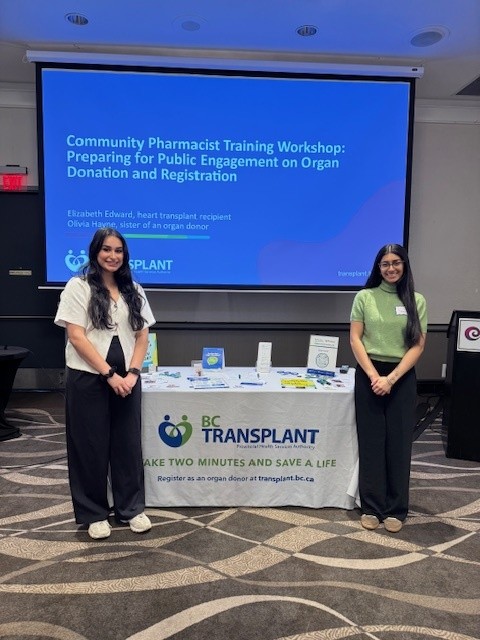
BC Transplant worked with two of its volunteers, Elizabeth Edward, a heart transplant recipient, and Olivia Hayne, the sister of an organ donor, to translate focus group findings into an overhauled training program tailored specifically to community pharmacy settings.
Then in March, the pair delivered the training to 11 pharmacists from Nanaimo locations of Central Drugs and Save-on-Foods, focusing on how to introduce organ donation conversations in a way that aligns with existing workflows. The workshop emphasized flexibility and practical application, rather than scripted messaging.
Olivia remarks, “In a world where community pharmacists are already asked to do so much, I am thrilled to see their excitement and enthusiasm.” Elizabeth agrees, and adds, “It’s been incredibly rewarding to be involved from the very beginning of a project that we hope will grow across the province.”
Olivia and Elizabeth have been supported by an advisory committee of additional BCT volunteers who provided additional feedback at every step of the project.
On April 14 and 15, the project moves from training into practice.
At six pharmacies across Nanaimo — three Central Drugs locations and three Save-On-Foods locations — Elizabeth, Olivia and another BCT volunteer (Gurjit Pawar, two-time kidney recipient) will co-host engagement events for the public. Participating pharmacists will also initiate conversations with patients where appropriate, applying the approaches introduced during training.
The project will assess how organ donation discussions can be incorporated into routine pharmacy practice, while also measuring public response to the setting.
The impact of the initiative is already extending further.
Pharmacy students involved in the project recently organized their own awareness event at the UBC Nest, putting their learning into practice by approaching members of the public and starting conversations about organ donation.
In that single event, students held 100 conversations, collected 30 surveys and identified 20 individuals interested in participating in future research.
Though they initially felt apprehensive about starting conversations with the public about organ donation, that quickly changed and they learned to adapt conversations to each situation.
“Through this project, it was surprising to see how many people support organ donation but still aren’t registered and this was something we couldn’t ignore,” shares Satveer Sangha, third year student pharmacist. “Our campus event helped us translate our learning into meaningful action.”
The pharmacy initiative reflects a broader effort to identify effective, community-based approaches to organ donation awareness.
Insights from the Nanaimo pilot and related outreach activities will inform future work on how healthcare providers can support informed decision-making about organ donation in everyday care environments.
“This partnership aligns with both organizations' core missions: BC Transplant is committed to saving lives through organ donation and transplantation; Practice Innovation's focus is advancing public health through community engagement and creating opportunities for pharmacists to practise to their full scope,” comments Colleen. “Organ donation awareness is exactly the kind of meaningful, community-facing work that pharmacists are uniquely positioned to lead — and our hope is that this creates lasting, systemic change in how they engage with public health issues.”