It’s nearly impossible to sum up a career spanning almost five decades, but for nephrologist Dr. David Landsberg, one patient story says it all.
Early in his career, a woman from Vancouver needed a kidney transplant. At that time, living donor kidney transplantation wasn’t available in BC, so she and her living kidney donor had to travel to Toronto, where Dr. Landsberg was completing his training and caring for transplant patients.
A few years later, Dr. Landsberg moved to Vancouver to help establish the kidney transplant program at St. Paul’s Hospital. When that patient heard the news, she transferred her care from Vancouver General Hospital so he could continue to be her physician.
“This patient had polycystic kidney disease, which is a genetic disorder. So since her kidney transplant, two of her children have also received kidney transplants. I have cared for this family for almost 50 years!” Dr. Landsberg shares.
“I just talked to the daughter of my initial patient and let her know I was retiring. She was crying.”
It’s one of countless patient stories that remain with him.
“That’s what I’m going to miss tremendously…being able to talk to patients and have a relationship with them. There is nothing better than seeing someone coming to clinic for the first time after their transplant. I love it. It’s the best,” he says with a smile.
When Dr. Landsberg began his career, the outlook for people living with kidney failure was very different, particularly in BC.
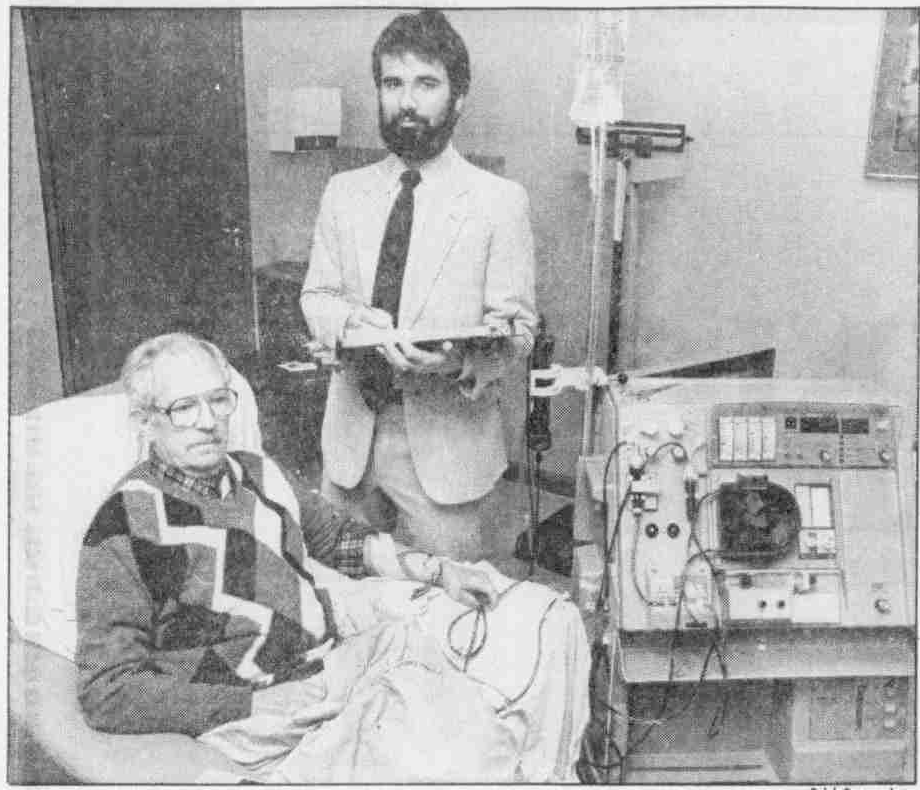
The first kidney transplant in BC was in 1968, but by the mid-1980s, there were still only about 35 kidney transplants performed each year, all at Vancouver General Hospital. There was no organized provincial organ donation program, and donation and transplantation often depended on individual physicians and hospitals working together. Pictured left is Dr. Landsberg in February 1986 with a kidney patient, just a couple of months before the first kidney transplant at SPH in April of that year.
“Nephrologists around the province, especially at St. Paul’s, were increasingly recognizing that their patients weren’t getting access to transplant when they should have.”
One physician in particular, Dr. Robin Hutchinson, who was a kidney patient himself and also served as the assistant deputy health minister, championed the creation of a transplant program at St. Paul’s and an independent provincial organ donation program.
When the province approved the new program, Dr. Landsberg was recruited to lead it. The first kidney transplant at St. Paul’s Hospital took place on April 20, 1986.
“I was planning to stay in Toronto, but who could turn down the opportunity of a lifetime?” he says. “Most transplant programs in Canada had started in the 1960s, so the chance to start a program from scratch, for me, was an unbelievable gift.”
Soon after, BC started doing living donor kidney transplants too. Combined with the growth of deceased donor transplantation, the landscape for patients in BC instantly transformed, and many more people with end stage kidney disease could finally get their second chance at life.
April 1986 also marked the launch of BC Transplant.
Initially, the organization had just two organ donation coordinators. Whenever they were unavailable, Dr. Landsberg stepped in.
“I would go on retrievals and I would do everything the coordinators did. I’d arrange the logistics, and then in the operating room, perfuse the kidney, put it on ice,” he recalls. “We weren’t doing heart, lung or liver transplants yet so programs from elsewhere, such as Seattle, would come and recover those organs. I was in my early 30s so I had lots of energy!”
The following year, BC Transplant recruited Dr. Paul Keown, a transplant immunologist, to lead the organization and expand transplant programs to heart, lung and liver. By 1988, BC had begun catching up with other provinces in organ donation and transplantation.
As BC Transplant expanded, Dr. Landsberg was able to focus entirely on kidney transplants. He later served as BC Transplant’s provincial medical director for transplant for several years as well as the medical director of renal transplantation at St. Paul’s.
Working alongside colleagues at Vancouver General Hospital, the teams established common criteria for transplant waitlisting and equitable policies for organ allocation.
At the same time, advances in immunosuppressive medications dramatically improved transplant outcomes.
The introduction of cyclosporine significantly reduced organ rejection, while tacrolimus, introduced more widely in the late 1990s, further improved long-term transplant success and quality of life.
Several of the first patients transplanted at St. Paul's in 1986 are still doing well nearly 40 years later.
Although tacrolimus remains the standard treatment today, Dr. Landsberg says developing even better medications remains one of transplantation's greatest opportunities.
Dr. Landsberg credits BC Transplant with helping transform organ donation and transplantation across the province.
"BC Transplant's only role is donation and transplantation, so from the beginning it was able to secure provincial funding for infrastructure, transplant programs and medications that individual hospitals simply couldn't access," he says.
"BC Transplant has been able to accomplish so much as a provincial organization, and that's the number one reason for our success."
The journey wasn't without setbacks.
During the early 2000s, BC's deceased organ donation rate consistently trailed the Canadian average.
Dr. Landsberg says much of that changed after Dr. Greg Grant became executive director in 2010.
"He made it clear that organ donation is part of good end-of-life care—not because patients are waiting for transplants, but because it's what many families want for their loved one."
Under Dr. Grant's leadership, BC Transplant also expanded its team of organ donation coordinators, allowing specially trained professionals to support families through donation conversations after all lifesaving treatment options had been exhausted.
Today, BC is recognized as a national leader in organ donation and transplantation.
In 2025 alone, 357 kidney transplants were performed, bringing the provincial total to more than 8,000 kidney transplants.
Looking back, Dr. Landsberg is amazed by how far transplantation has come.
"I never imagined we'd be transplanting people in their 80s, or that patients would still be doing well more than 40 years after their transplant," he says.
"When I started, if someone kept their transplanted kidney for 10 years, that was considered a tremendous success. Today, we're seeing outcomes I never would have imagined."
While he looks forward to spending time with his newly-arrived first grandchild, retirement won't take him far from the profession that shaped his life.
His younger daughter is now following in his footsteps as a nephrologist.
But when asked what he'll miss most, his answer comes without hesitation.
"The patients," he says. "That's what I'm going to miss tremendously."